
Preventive Document Review: Why Builders Are Trusting Software to Catch Errors Before Construction
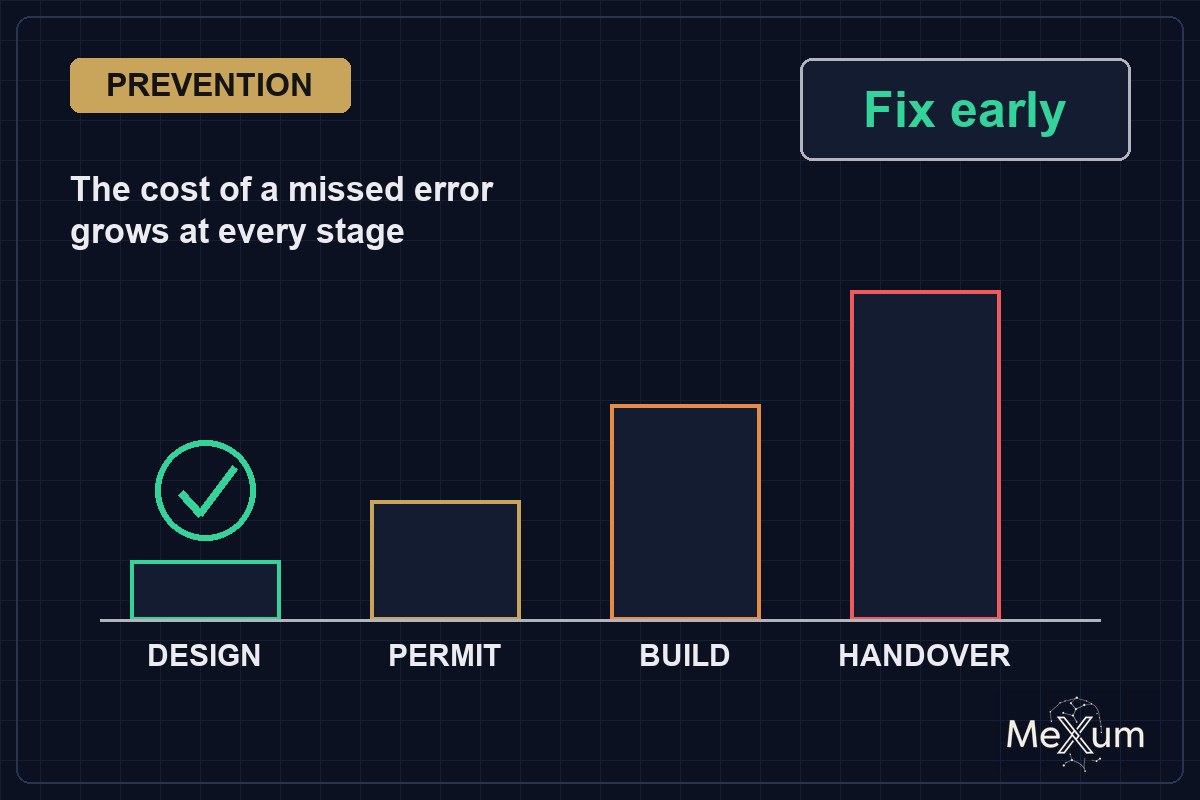
Most construction errors are not made on site. They are made months earlier, on paper: a quantity that does not match the drawings, a specification that contradicts another sheet, a line item counted twice, a requirement nobody priced. On paper, fixing such an error costs an email. Once concrete is poured, it costs rework, delay and a dispute over who pays.
That is why more owners, contractors and lenders are moving document checks to the front of the project, and why they increasingly let software do the first pass.
What poor project data costs
The scale is large. A 2021 study by Autodesk and FMI, based on a survey of more than 3,900 professionals, estimated that bad data cost the global construction industry about $1.85 trillion in 2020. The same study attributed $88.69 billion of rework that year, around 14% of all rework, to bad data: information that was inaccurate, incomplete, inconsistent, inaccessible or late (Autodesk and FMI).
An earlier PlanGrid and FMI report, Construction Disconnected (2018), found that miscommunication and poor project data account for 48% of rework on U.S. construction projects (Autodesk). These are industry estimates rather than audited figures, but the direction is clear: a large share of what the industry pays to fix starts in documents.
Why the timing matters
The same error has a very different price depending on when it is found:
- During design: the designer corrects a sheet or a schedule.
- At permit or plan review: the package comes back with comments, and the resubmission cycle costs weeks.
- During bidding: a missing scope item becomes a change order later, usually at a worse price.
- During construction: the error turns into rework, idle crews and claims.
Preventive review simply means checking the documents before each of these decision points, not after something has already gone wrong.
Builders are starting to trust software with the first pass
Manual review is still the norm, but it is slow and depends on how much time a reviewer has. A full package can run to thousands of pages, and the errors that matter most are often cross-document: a quantity in the estimate that does not match the drawings, or a note on one sheet that contradicts another. That is exactly the kind of systematic comparison software is good at.
Public authorities are moving the same way. Singapore's CORENET X submission portal includes a Model Checker that project teams are asked to run during design and before submission, so that model issues and non-compliances are caught before the agencies see the package (CORENET X).
In the industry, adoption is real but early. Surveys in 2025 range from about one in three construction professionals already using AI in their business (Houzz, via BD+C) to most companies still at the stage of initial discussions (RICS). The trend is toward using software where it is strongest: fast, consistent checking of large document sets, with people making the final call.
What to trust a software check with, and what not
A good automated check should earn trust the same way a good reviewer does, by showing its work. Look for three things:
- Evidence: every finding points to the page and quotes the text it is based on, so your team can verify it in seconds.
- Honesty about limits: where the documents do not allow a conclusion, the tool says "not verified" instead of guessing.
- A clear role: it prepares your team for plan review, bidding or a lending decision. It does not replace plan review, a licensed professional or the authority having jurisdiction.
How MEXUM fits in
MEXUM checks project documents, drawings, estimates and contracts before the key decision points: before submission, before bidding, before closing a construction loan and before work starts. Each finding is backed by a quote and a page reference. See how it works for a plan review pre-check and an estimate review.
This article is general information. Requirements depend on your jurisdiction, the adopted codes and the type of project; consult a qualified professional for your project.
Frequently asked questions
What is preventive document review in construction?
Checking drawings, specifications, estimates and contracts before key decision points such as permit submission, bidding, loan closing and the start of work, so errors are fixed on paper rather than on site.
How much rework is caused by poor project data?
Autodesk and FMI estimated that bad data drove $88.69 billion of rework in 2020, about 14% of all rework. A 2018 PlanGrid and FMI report linked 48% of U.S. rework to miscommunication and poor project data. Both are industry estimates.
Can software replace plan review?
No. Automated checks help prepare a package and find inconsistencies early, but plan review, licensed professionals and the authority having jurisdiction remain responsible for approval.
How do I know an automated finding is correct?
A trustworthy check quotes the text it relies on and gives the page reference, so your team can confirm each finding in the source document.