
Construction Document Review: A 12-Point Checklist Before You Bid or Build
Most construction documents get their first real review at the worst possible moment: during permit review, during bidding, or on site, when a trade asks "which drawing is right?" Every one of those moments costs more than catching the problem earlier would have.
A construction document review is a systematic check of the drawings, specifications, schedules and estimate for gaps, conflicts and mistakes before you submit, bid, sign or build. Below: the 12 places where errors hide, a 7-step way to run the review yourself, who else can do it, and what it costs.
What a construction document review actually checks
Three things, in this order:
- Completeness. Is everything there: all sheets, all specification sections, every schedule the drawings refer to, and the addenda?
- Coordination. Do the pieces agree with each other: architectural vs. structural vs. MEP, drawings vs. specifications, plans vs. schedules, drawings vs. the estimate?
- Compliance. Do the references and requirements match the code editions and standards your jurisdiction has adopted, and are the cited versions still current?
Why review before submission: the arithmetic of delay
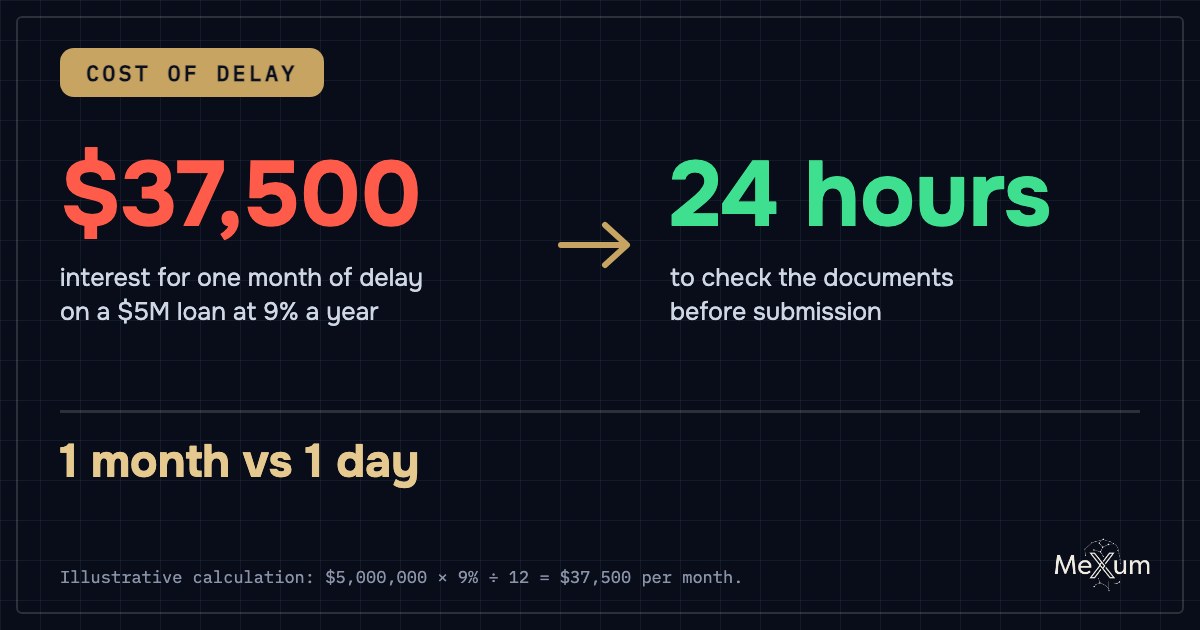
A comment letter from plan check, a bid that has to be re-priced after an addendum, or a change order caused by a drawing conflict all share one property: they arrive after the schedule has started to run. Take a project financed with a $5 million construction loan at 9% a year. One month of delay costs $37,500 in interest alone ($5,000,000 × 9% ÷ 12), before overhead, idle crews or escalation. That is an illustration, not a forecast, but the proportions hold on most projects: the delay costs far more than the check.
The 12 places errors hide
These patterns repeat from project to project, so it pays to check against a list:
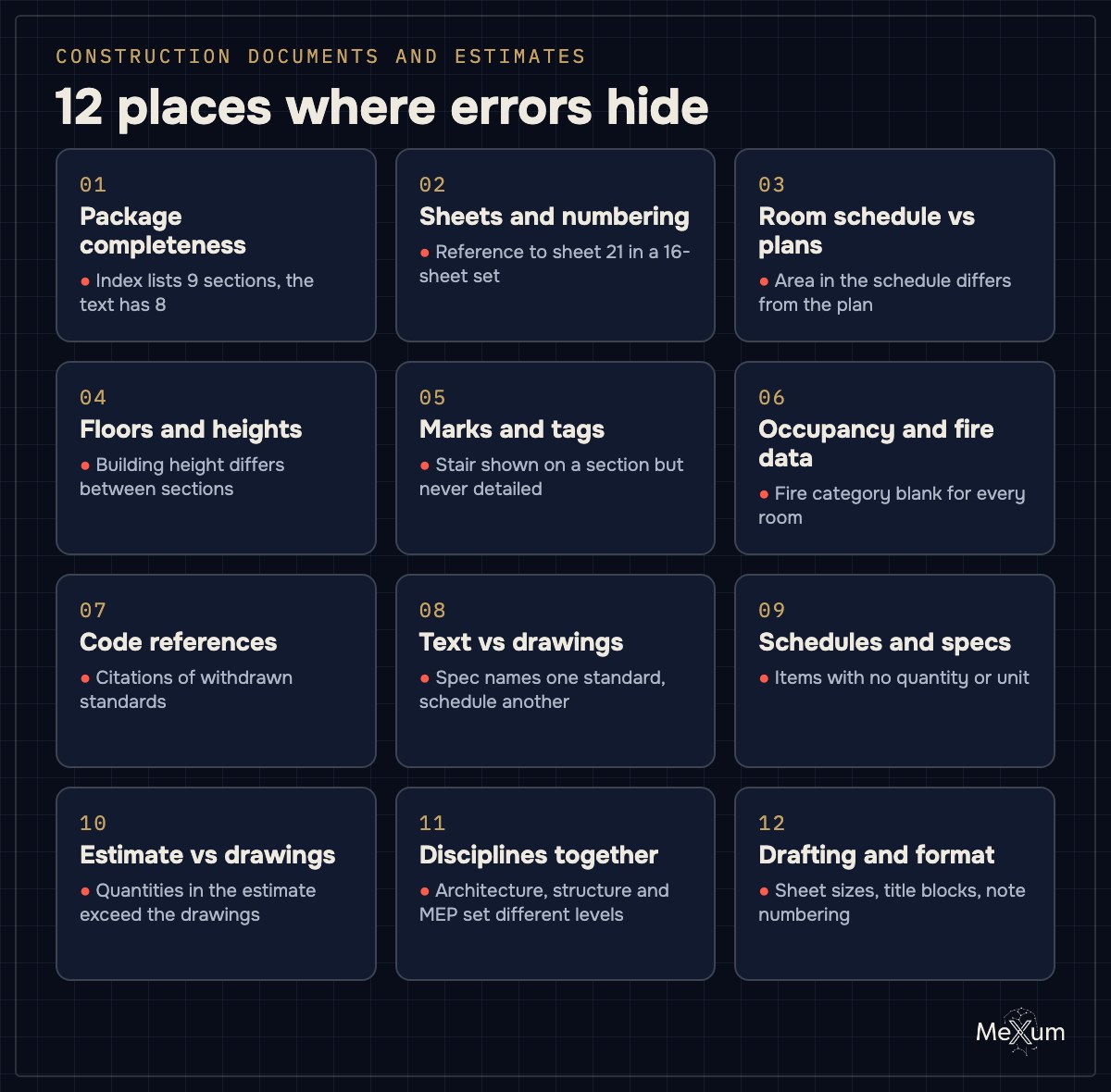
- Package completeness. The index lists nine sections, the text has eight. Sheets referenced in the index are missing from the set.
- Sheets and numbering. A note points to sheet 21 in a 16-sheet set. Revision clouds without a revision entry.
- Room schedule vs. plans. The area in the schedule differs from the area measured on the plan, so everything priced per square foot is off.
- Floors and heights. Building height or story count differs between the narrative, the sections and the code summary.
- Marks and tags. A stair, door type or wall type is tagged on a plan or section but never detailed or scheduled.
- Occupancy and fire data. Occupancy classification, fire ratings or egress data are blank, or shown in the legend but not on the plans.
- Code references. Citations of standards that have been withdrawn or superseded, or of an edition your jurisdiction has not adopted.
- Text vs. drawings. The specification names one product standard for a door, the door schedule another.
- Schedules and specs. Line items with no quantity, no unit, or a gap in the numbering.
- Estimate vs. drawings. Quantities in the estimate that cannot be reproduced from the drawings. See how to check a quantity takeoff.
- Disciplines together. Architecture, structure and MEP use different floor levels, grid lines or opening sizes.
- Drafting and format. Sheet sizes, title blocks and note numbering. Small, but plan check comment letters are full of them.
Notice that most of these errors live between documents rather than inside one. Each sheet can be correct on its own while the set is inconsistent, and that is exactly where human review is weakest: nobody can hold a few hundred numbers in their head across forty sheets.
How to run the review yourself: 7 steps
- Reconcile the index. Compare the sheet index and specification table of contents with what is actually in the set, including addenda.
- Follow every reference. Each "see sheet…" and "per section…" has to land somewhere real.
- Check the numbers that repeat. Areas, heights, story counts, and door and window counts on plans versus schedules.
- Match tags to details. Every tag on a plan needs a detail and a schedule row, and every schedule row needs a tag.
- Verify code and standard references. Are the cited editions current and the ones your jurisdiction uses?
- Cross-check the disciplines. Levels, grids and openings across architecture, structure and MEP.
- Tie the estimate to the drawings. Start with the most expensive line items. A quantity gap usually means an error in the estimate or in the drawings.
The weakness of the manual route is steps 3, 6 and 7: they need hundreds of figures compared against each other, and that is where reviewers get tired. It makes sense to hand the repetitive cross-checking to software and keep the judgment calls for people.
Who can review your documents
- The designer (internal QA/QC). Cheap and fast, but reviewers rarely see their own mistakes. Good as a first pass.
- An independent reviewer or third-party consultant. Deep and credible, but usually measured in weeks and priced by the size of the set.
- AI document review. Fast and exhaustive: software does not get tired and compares every figure with every other. Decisions on how to fix an issue stay with the design team.
MEXUM is the third option. You upload your documents, a team of specialized AI experts checks them in parallel and against each other, and you receive a written report as a PDF within 24 hours. For where AI helps and where it does not, see what AI estimate review catches and misses.
What the report looks like
A useful report is a working list, not a verdict. Each finding names the location in the documents, what does not agree, the requirement or reference behind it, a suggested fix and a severity level. Totals are computed from the finding list itself, so the numbers on page one always match the table.
Document review for different project roles
- Designers and architects. Insurance against comments at the seams between disciplines and against missing sheets.
- Owners and developers. A way to accept the design team's work without taking it on trust: you get a list of conflicts, with locations, that you can send back.
- Lenders. The quality of the borrower's documents drives schedule and budget risk. An independent check before the funding decision reduces uncertainty. See what to verify in the borrower's budget.
- General contractors. Conflicts in the set surface on site as extra work and disputes. They are cheapest to find before you sign.
What a document review costs
Market prices depend heavily on the size of the set and the turnaround, so there is no honest "average." For AI review at MEXUM, a trial review of one document is $100, delivered within 24 hours, and plans for ongoing work start at $999. Compare it not with doing nothing, but with the cost of a month of delay: if a month costs tens of thousands of dollars, a single critical conflict found before submission pays for the review many times over. More detail in what an estimate review costs.
What a document review does not do
- It is not a permit, a plan check or a professional engineer's sign-off, and it does not guarantee approval.
- It does not remove responsibility from the design professionals; people make the decisions.
- It cannot check what is not there: if a discipline is missing or a sheet is an unreadable scan, the report says so instead of saying "no issues."
Where to start
Take the set you are about to submit or bid, or one that already drew comments. Upload it, and compare the report after 24 hours with your own list. That is the most honest way to find out whether a review is worth it for you.
Frequently asked questions
What is a construction document review?
A systematic check of drawings, specifications, schedules and the estimate for gaps, conflicts and mistakes before you bid, sign or submit them for permit review. It focuses on completeness, coordination between documents, and consistency with the codes and standards cited.
Is a document review the same as plan check?
No. Plan check is the jurisdiction's official review needed to get a permit. A document review is an optional check you run beforehand so the set reaches plan check with fewer comments.
How long does a construction document review take?
It depends on who does it. An internal QA/QC pass takes days, an independent consultant usually takes weeks, and MEXUM's AI review returns a written report within 24 hours of upload.
Can AI replace a plan reviewer or an engineer?
No. AI review finds conflicts and omissions before submission, but it does not replace plan check, professional review or sign-off. The report is advisory and the design team makes the decisions.
What should I upload for the best result?
The drawings as PDF, the specifications, the schedules and, if you have them, the estimate or quantity takeoff and the contract. The more of the package you include, the more conflicts between documents can be found.
How much does a document review cost?
At MEXUM a trial review of one document is $100 with results within 24 hours, and plans for ongoing work start at $999. Prices of other providers vary with the size of the set and the turnaround.