
AI Construction Estimate Review: What It Catches and What It Misses
"Can AI check my construction estimate?" is now a common question from homeowners, contractors and lenders. The honest answer is: yes for some things, no for others. Here is where the line is.
What AI review reliably catches
- Math and rollups. Subtotals that do not add up, markup or tax applied twice, or a section total that never reached the grand total. On a 300-line estimate these are the errors humans miss.
- Duplicated scope. The same work priced under two trades, such as "subfloor prep" in framing and again in flooring.
- Missing scope. Waterproofing absent from a tiled shower, demolition with no haul-away, electrical rough-in with no patch-and-paint. Comparing against a typical scope list exposes the holes.
- Unit and quantity problems. Square feet priced as linear feet, 1,200 SF of drywall in a 900 SF room, quantities that disagree with the drawings or the takeoff.
- Inconsistent markups. Overhead and profit percentages that change from section to section, or contingency stacked on top of allowances.
- Vague line items. "Misc. materials" or "lump sum, as needed" with no basis; these are where budgets usually leak.
What it cannot do
- See the site. If quantities are inflated and the drawings do not show it, the document alone will not reveal it.
- Know today's local pricing. AI compares against reference data. Supplier prices and labor rates in your market move faster than any dataset.
- Hear verbal agreements. A promised material substitution that is not in the estimate is invisible.
- Take professional responsibility. An AI report is decision support. It is not a stamped engineering review or a substitute for a licensed estimator.
How to tell a useful review from a vague one
- Every finding points to a line. Section, item number, quantity. "Some items look high" is not a finding.
- Every finding says why. What it was compared to: the drawings, another line, a contract term, a reference range.
- Findings are ranked. Critical, potential risk, informational. Otherwise you get a hundred notes and no priorities.
- The tool admits uncertainty. Be wary of "we find everything" or guaranteed savings.
How to use the results with a contractor
Do not forward a raw report. Pick the five to ten findings with the largest dollar impact and phrase them as questions: "Line 14 shows 120 SF; sheet A-3 shows 96 SF. Which is right?" A good contractor will explain or correct. Vague answers to specific questions are also information.
What to upload for the best result
Estimate plus drawings (or a quantity takeoff), the contract and the schedule. An estimate alone can be checked for internal consistency and reasonableness; an estimate checked against the drawings and the contract can be checked for contradictions between them.
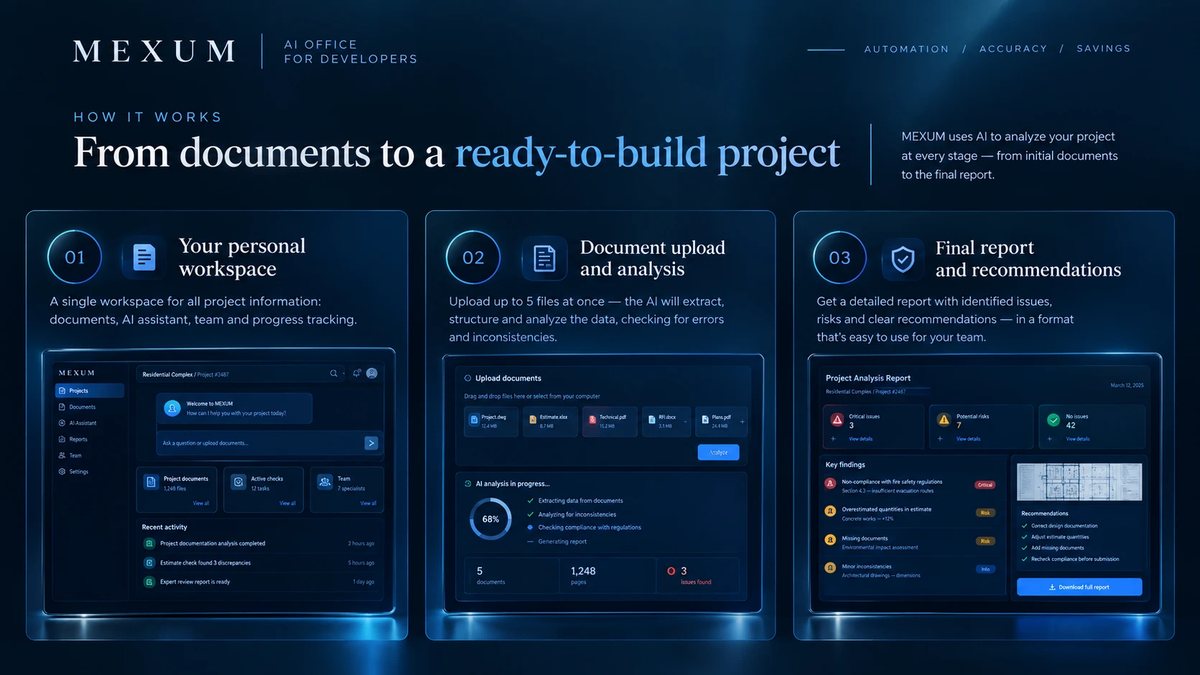
MEXUM runs this as a team of specialized AI experts (estimator, structural, contracts and others): upload your documents and receive a report with findings, references and severity levels. Final decisions on disputed items stay with you and your professionals.
Frequently asked questions
Can AI check a construction estimate?
Yes, for what can be verified from documents: arithmetic, duplicates, missing scope, unit and quantity mismatches, and inconsistent markups. It cannot see the jobsite or replace a licensed estimator, so treat results as decision support.
Is AI estimate review accurate?
It is reliable on checkable facts such as math and cross-document contradictions, and less reliable on current local prices or site conditions. Ask for findings with line references and reasons so you can verify them quickly.
What documents do I need for an AI estimate check?
At minimum the estimate in Excel or PDF. For a deeper check add the drawings or a quantity takeoff, the contract and the schedule, so quantities and terms can be compared across documents.
Does AI replace a professional estimator?
No. AI quickly checks the whole document and surfaces issues; a professional decides which findings matter, negotiates with the contractor and takes responsibility. The combination is faster and cheaper than either alone.